
For the Best
my poetry chapbook is out now!

Releasing a book is a release of energy. Pent up movement, flurrying metaphors, quick conversations, twenty-four pages, printed neatly. No red ink, tearstains, or rips at the paper are apparent, but that’s what it looked like to write For the Best. If time and anger can yellow pages, this book would be brittle when it reaches you. Fortunately, the feeling of publishing a book isn’t the reality, so you can buy my new chapbook now- it contains no damages that aren’t emotional.
How to even talk about my book, where to begin? Obviously, the easiest place for me to start was a sales pitch. It has the dual purpose of not being too personal while appealing to a competitive attention economy.
Really, though, I should begin with when I first started drafting these poems. In March of 2023, I had a half-formed first draft, a title, and a goal. On spring break of that year, I journaled about my goals for this book:
“This chapbook is about rediscovering what writing means to me. It’s more than habit, compulsion. It’s an act of love. It’s my passion. Writing a book is for me, before it’s for anyone else. I don’t need anyone’s validation that I’m impressive or doing enough. I just want to have fun with it. I write because despite everything, I will always love it, no matter what form it takes in my life.”
3/25/23
Re-reading my entry feels self-indulgent. I find it difficult to be a writer that talks about her writing. I’m trying to change that, to write about this book and what it means to me.
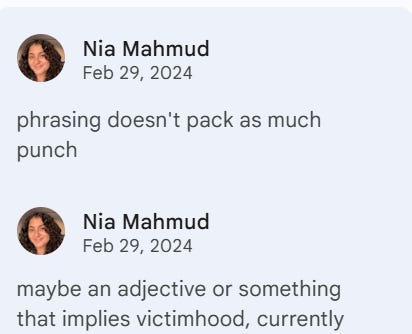
This past summer I began to see my book approach a final draft; this was a bit more than a year after the above journal entry. I spent a lot of time interrogating the poems until they were what I wanted them to be: this is the best way I know to explain it. In the spring, a few months before my final edits, I asked my friend Nick if he could look over my drafts. We Facetimed after he looked it over and left a few marks on the google doc. I questioned every line, held every metaphor up to the light. We had a conversation with the poem together. I asked if imagery was too on the nose, if that line was singing in the right note, if the space between past and present was big enough or if I needed a line break. It’s not an exaggeration. We both saw it as an art. When I asked about the poem’s feelings, Nick had a straight face and a meaningful suggestion.
For the Best. I can’t ever imagine the contents of a book I’ll write until it exists. Maybe this seems inherent to the process; but for a while I was resistant to the idea that creative writing would involve giving up control. I thought I could plot out every point and predict every turn of phrase. Instead, I found that my joy in writing comes from discovery, not a predetermined path a poem follows. When I let go of ideas of how my book was supposed to look, I allowed it to become what it is. There was a pang of nostalgia in my chest when Nick suggested a different word or a new stanza. I was fifteen again, sharing a short story about a squirrel who befriends a little girl in a park to the same email address. I recall the pit in my stomach; the fear that my writing wasn’t good enough. What shines brighter in my memory is the smile I wore after Nick read my story. He told me it was great, to keep writing, to always keep writing. Nick is a high school English teacher now, and I couldn’t have imagined something more fitting. I hope there are more students that hear the encouragement they need to keep writing.
After publishing my first poetry collection three years ago, my next goal was to publish a second book before I graduated college. I wanted to write a novel. Instead, I kept drafting poems. I collected ideas, images, made-up scenarios, and placed them all in an unnamed document. I wasn’t sure what there was to be made out of scraps. It’s no secret I’m not the biggest fan of my first collection of poetry. A new project was looming and at the time, it was a frightening feeling. What if I tried it again and it wasn’t as good as I wanted it to be? What if the poems sounded the same, what if the poet is unchanged?
In Fall of 2022, in the midst of resisting putting together a collection, I knew what the title was. I don’t rush my titles. They appear to me early on in my writing process, but I don’t beg for them. At this point, I had half of a first draft. Themes had started to emerge. Grief for endings and beginnings. The way aches change when you study them. Wanting. Wanting, and wanting, and wanting, with a fury my metaphors couldn’t keep up with, and how time renders wants obsolete in the face of needs. For the Best. Everything I was learning and would learn was for the best. Once I had my title, I knew I needed to see it through. I wanted to challenge myself with interesting ideas, imagery, and formats.
This past summer, in June of 2024, I read “The Idiot” by Elif Batuman. It took two months for me to read, largely because it had so much sprawling prose to digest. Missing one line meant missing a self-contained universe. I don’t have my copy with me so I can’t cite the exact quote or page, but there’s a scene where the novel’s protagonist and narrator, Selin, sees snowflakes swirling on the street. They sweep up into the sky in a mini whirlwind, moving of its own accord. A thread that runs throughout the book is Selin questioning what’s important to her, what her values are, what she finds worth noticing. Selin is frustrated with the nonimportance of the snow on the street because it doesn’t stop her from fixating on it. I was editing my collection at the time, and even if the scene is a bit muddled in my telling, the message I took from it allowed me to recontextualize what I was writing. It reads in every poem. I was preoccupied with the idea that the people around me wouldn’t care about small wonders, or that I would lose the ability to believe. My favorite line in the collection is in the last poem, but I wrote it in the first draft:

I wrote this so early on that the idea became my framework. Do I believe in the God of my childhood is what I question in a larger sense, but the idea is at once smaller and bigger than that. Do I believe in investing in myself, in being more than romanticized suffering? What kinds of idols have I asked for absolution and where have those misplaced questions gotten me? Throughout the collection, I assign purpose to many ideas. Apologies, burrow owls, pimples, confessions. This is clear when zooming out. In the midst of editing or in the middle of a metaphor, the question is different: what do I believe in, and how do I think those ideas will save me? Coffee saves when it’s pushed across the table, but I don’t zoom in to when the cup is drained; nothing but dregs in the face of longing eyes. Learning what my book was as I created it was my favorite part of the process.
A part of publishing I enjoy less comes back to how I started this essay: actually talking about it. When discussing my work, I resist the urge to overexplain it. I am not the narrator, I am the author, and my collection is clear enough on its own. And I’m proud of my work, all my painstaking edits. The truth about this period of time is something I don’t give often. I scribbled on the margins of my manuscript while on a road trip. The canned coffee Isabella and I bought the day before was lukewarming in the cupholder beside me, and the music playing must have been on repeat all summer. Faye Webster, SZA, various artists that don’t transport me back to the car with my pink pen in hand until I hear the specific song again. Editing and living at the same time allowed the collection to be what I wanted it to be. I don’t know how to put this in a blurb.
Read this if you want to read poetry. Read this if you’ve never gotten over anything, ever. Read this if the ache is a refrigerator wire that never stops stinging, if someone’s coldness has cut you open. Read this if you’re trying to meet your reading goal. Read this if you save book recommendations. Read this if you want to see me take poetic leaps and risks (?) Read this if your forearm is still sticky from biting into a plum and letting the sugar coat your lips. Read this if you are still laughing. Read this if they are still gone, read this if grief shapeshifts. Read this if your favorite song says a lot about you. Read this if you’ve spilled boba in the passenger seat and someone has said it’s okay, I’ll clean it.
All this to say: For the Best is published and for you to read. I am so proud of this project, and writing it was an immense joy. Having it be published with the publisher I had in mind since my first draft is so rewarding. I felt so encouraged on the day of publication in November, when friends and family reached out to congratulate me. It’s still frightening to release a book; to say I wrote this and it’s the best it can be. This time around, it’s easier to believe. It wrote this, and it’s good. I am older and better; in this case there is causality.
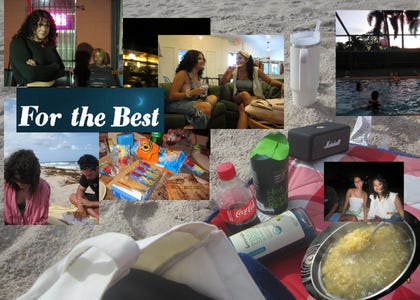
Thank you so much for reading! I’m aiming to be more active on Substack this year, so anticipate more essays and writing here. Below is all the For the Best information you need: the link on Bottlecap Press where it’s available for purchase as a physical copy or a PDF, the link to the StoryGraph and GoodReads page to add it to your TBR or write a review if you read it, and one of my favorites, a link to the Pinterest board I made inspired by the poems!
Buy For the Best here
Congratulations, Nia!!!